
REVIEW · BARCELONA SEGWAY TOURS
2,5h Barcelona Gaudí Segway Tour
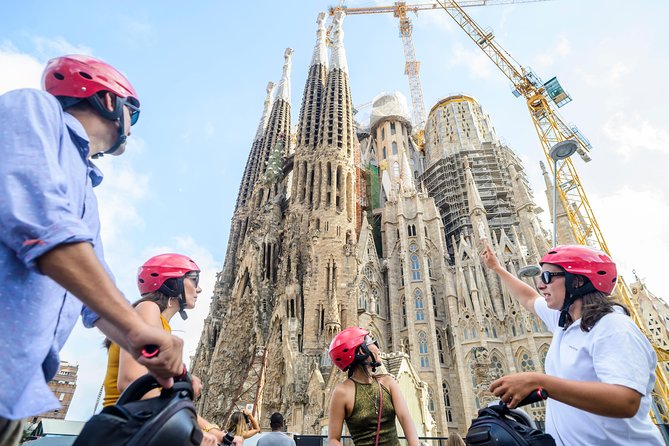
Barcelona is made for rolling tours. This 2.5-hour Gaudí Segway tour links the Gothic quarter, waterfront, Ciutadella Park, Eixample, and Sagrada Família without asking you to cross the city on foot. You get live commentary from a local guide and frequent chances to stop for photos.
I like the broad route, which gives you a useful first look at many of Barcelona’s key sights. I also like the morning and afternoon departures, plus the fact that a first-time rider over 65 found the experience easy and fun. The main drawback is the pace: with so many stops in 150 minutes, you see much of the city from outside rather than visiting interiors.
Key points to know before you roll
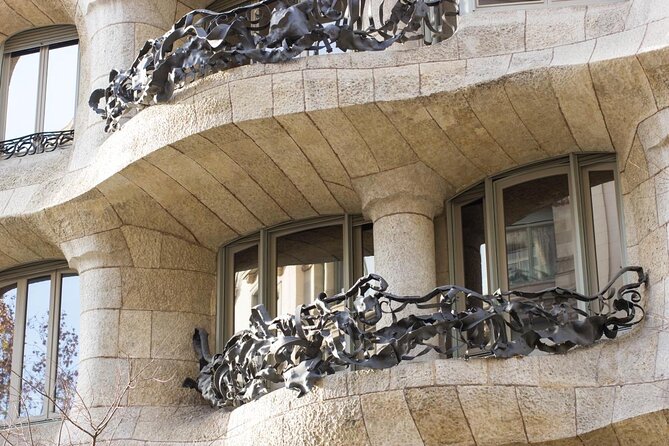
- A wide Gaudí route: See Casa Batlló, La Pedrera, Casa de les Punxes, Sagrada Família, and several less famous modernist sites.
- A city tour, not an entry tour: Admission to major buildings and monuments is not included, so plan separate visits if you want to go inside.
- A useful first-day activity: The route connects the waterfront, Born, Ciutadella, Eixample, and central Gaudí sights.
- Beginner-friendly equipment: The tour includes a Segway, helmet, and local guide. A previous rider described it as a first Segway experience even at over 65.
- Strict timing matters: Arriving more than 15 minutes late cancels the activity without a refund.
- Check the physical rules: Riders must be at least 14 years old, weigh 45 to 120 kilograms, and wear comfortable shoes.
Why this Segway route works in Barcelona
Barcelona’s main sights are spread across several districts. The old port sits below the Gothic quarter, Gaudí’s best-known houses line Passeig de Gràcia, and the Sagrada Família is farther northeast. Walking between all of them would take much of a day, while a standard coach can feel too removed from the streets.
A Segway gives you a middle ground. You cover more ground than on foot, but you remain close enough to see street details and stop at plazas, parks, and façades. I like that balance for a first look at Barcelona.
The tour lasts about two and a half hours and returns to the starting point. That makes it easy to fit into a morning before lunch or an afternoon after visiting another part of the city. The route includes modernist architecture, Gothic streets, public art, the waterfront, and major city landmarks, so you get more than a narrow Gaudí circuit.
Still, keep your expectations in check. The short stops listed along the route are mainly orientation points. You will hear about the places, take photographs, and continue moving. This is not the right choice if your main goal is a long interior visit at Casa Batlló or Sagrada Família.
A few more segway tours around Barcelona worth a look
- Barcelona Segway Tour
★ 5.0 · 680 reviews - Barcelona Segway Tour
★ 4.7 · 630 reviews - Barcelona: City Highlights Guided Segway Tour
★ 4.9 · 624 reviews
Starting at Tres Xemeneies and the old waterfront
The meeting point is at Jardins de les Tres Xemeneies on Avinguda del Paral·lel, near Teatre Apolo. This is a practical beginning because the area sits close to public transportation and gives you an immediate taste of Barcelona’s changing character.
The gardens are known for large-scale graffiti and urban art. That opening stop helps place modern Barcelona beside the older architecture you will see later. You may spend only a few minutes here, but the contrast is useful: Barcelona is not just Gaudí façades and medieval lanes.
From there, the route moves toward Las Ramblas and the Monument a Colom, the Columbus Monument at the lower end of the famous boulevard. The monument itself is not included as an admission visit, and the stop is brief. Think of it as a landmark for finding your bearings between the city center and the harbor.
You continue into Port Vell, Barcelona’s old port. This is one of the more enjoyable parts of the route because the city opens up around the water. The stop is free, but the tour does not include food or drinks, so save a waterfront meal for another time or plan it after the tour.
Pla de Palau, Born, and Ciutadella Park
The next section turns inland through Pla de Palau, where you can see lampposts associated with Antoni Gaudí. These are easy to miss if you are rushing between major attractions, which is one reason a guided route can help. You are not simply chasing the famous buildings. You are also given small examples of the architect’s work in public space.
The route then reaches El Born and La Ribera, two central areas with a very different mood from the broad avenues of Eixample. Stops include Estació de França, Barcelona’s historic train station, and El Born Centre de Cultura i Memòria, the former Born Market.
The market building is free to view from outside, while Santa Maria del Mar is listed as an additional stop later in the route. The Born section works best as a short introduction to the district. If you want a slower look at its streets, shops, or church interior, return on foot another day.
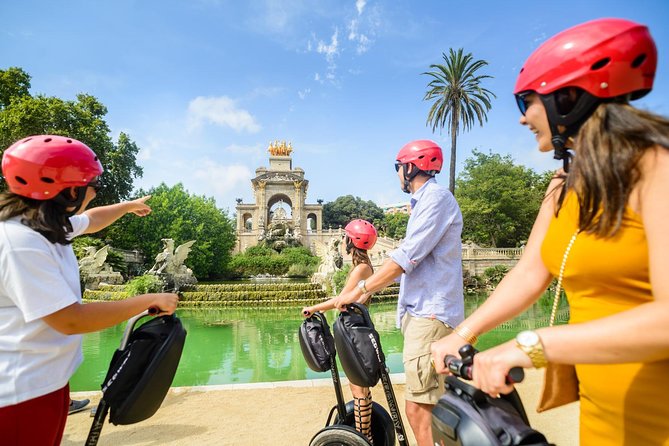
Parc de la Ciutadella gives you a welcome change from city streets. The route pauses at the park and at the Cascada Monumental, the grand waterfall monument linked with Gaudí. The park stop is free, and the space gives you room for photographs.
You also pass the Castle of the Three Dragons, a modernist building within the park area. Its exterior is particularly useful for understanding that Barcelona’s modernisme was larger than Gaudí alone. The tour does not include admission, so this is another sight to mark for a separate visit if its interior interests you.
Arc de Triomf and the wide streets of Eixample
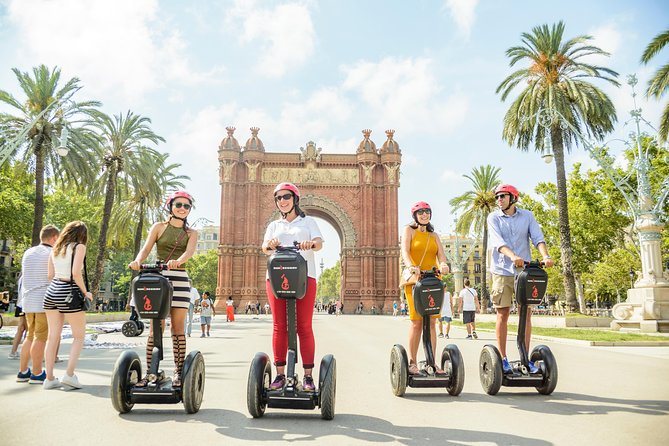
From Ciutadella, the Segways head to the Arc de Triomf. Unlike many triumphal arches, Barcelona’s was built for a world exhibition and functions as a striking entrance to the long promenade beyond it.
This is a good place to appreciate the city’s scale. The broad avenue makes sense on a Segway, giving you a smooth connection between the park and Eixample. The stop is short and admission is not included, but the arch is easy to photograph from outside.
Eixample is one of the most important parts of the route. Its large blocks, clipped corners, and long avenues make Barcelona feel very different from the compact old quarter. You then reach Passeig de Gràcia, the city’s grand modernist boulevard.
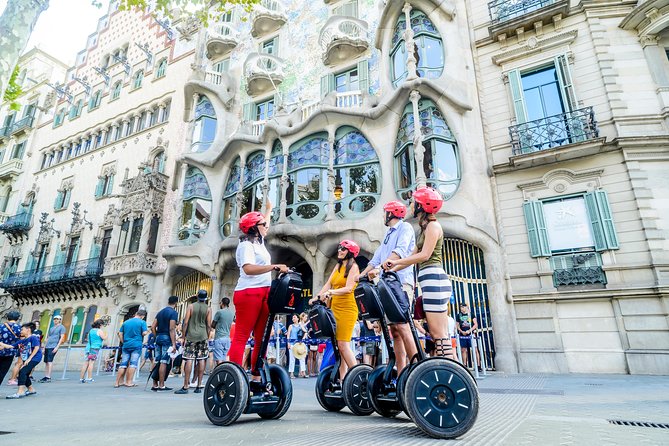
Here, architecture becomes the main event. The route pauses at Casa Batlló and La Pedrera, also called Casa Milà. These are two of Gaudí’s best-known works, and both are exterior stops on this activity. Admission is not included, so do not confuse seeing the façades with visiting the buildings.
Casa Batlló is famous for its unusual curves, colorful surface, and bone-like details. La Pedrera presents a more solid, sculptural face, with a famously irregular roofline. Seeing both close together helps you compare Gaudí’s changing approach, even if you only have a few minutes at each.
I consider this part especially valuable for first-time visitors because it gives you the architectural context to choose a building for a later, longer visit. If you already have timed tickets for Casa Batlló or La Pedrera, use this ride as a preview rather than trying to fit an interior visit into the tour.
Same place, a completely different route:
- Barcelona: 2-Hour City Sights Guided Segway Tour
★ 4.9 · 610 reviews - Barcelona: Guided Segway Tour
★ 4.8 · 412 reviews - Barcelona Guided Tour by Segway
★ 5.0 · 374 reviews - Barcelona: City and Seafront Guided Segway Tour
★ 4.9 · 317 reviews
Casa de les Punxes and Sagrada Família
The route continues along Avinguda Diagonal toward Casa de les Punxes. This modernist building has a pointed, castle-like appearance and is less familiar to many first-time visitors than Gaudí’s famous houses. The stop adds variety and shows how broad the modernist movement was across Barcelona.
Casa de les Punxes is an outside stop, with admission not included. That matters because the building can look like a quick photo stop from the street, yet it deserves more time if you want to study its details.
The tour then reaches the Basilica de la Sagrada Família. This is the headline stop for many people, but the time limit changes how you should approach it. You will view the exterior and hear live commentary, not enter the basilica as part of the tour. Admission is not included.
That arrangement has a clear advantage. You can see where the basilica sits in relation to the surrounding city and get a quick introduction before deciding if you want to return for a full visit. The disadvantage is equally clear: the Sagrada Família deserves more than a few minutes if you want to understand its interior, towers, museum, and symbolism.
The route also passes the Monumental bullring. The building offers another example of Barcelona’s architectural mix, especially when seen after the modernist landmarks. It is not the tour’s main focus, but it helps break up the string of Gaudí stops.
Returning through Born and Santa Maria del Mar
The final portion returns toward El Born, including another stop at El Born Centre de Cultura i Memòria and the Basilica de Santa Maria del Mar. This return route gives you a second look at an area that often rewards a slower visit.
Santa Maria del Mar is one of Barcelona’s notable Gothic churches, and its presence on the route keeps the tour from becoming only a modernist architecture outing. You will see the basilica from outside, with admission not included.
That mix is one of the tour’s strengths. In a single ride, you move from graffiti art to the old harbor, from Gothic buildings to modernisme, and from a medieval district to Gaudí’s major works. The route is broad enough to help you understand how the city’s neighborhoods relate to each other.
The tradeoff is that the itinerary can feel packed. Many listed stops are about five minutes each, and some are brief pass-by points rather than extended visits. I would use the tour to make a shortlist of places for later, not to replace those visits.
The guide, group size, and riding experience
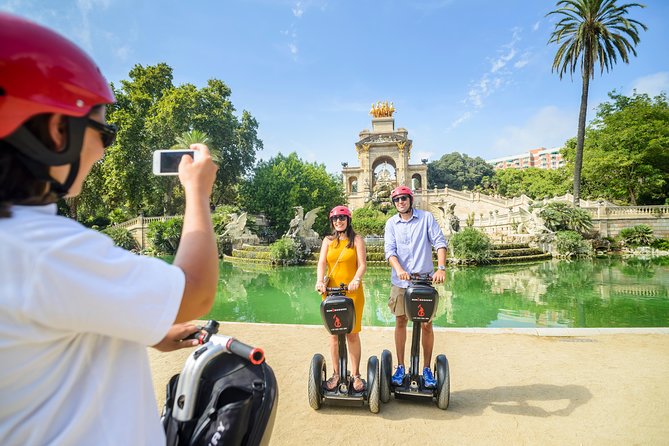
A local guide provides live commentary during the ride. The guide may be multilingual, so ask at the start if you need clarification or want to confirm the language of the explanations.
The maximum group size is 30 people. That is not a tiny private outing, and the experience may feel less personal when the full group is present. On the other hand, the Segway format lets you cover a long route without the stop-and-start pattern of a large walking group.
The equipment includes the Segway and a helmet. If this is your first time, arrive ready to listen closely to the initial instructions and practice. The available feedback is encouraging for older beginners: one rider, over 65, described this as a first Segway experience and praised the fun, the amount seen, and the time available for photographs.
The age rule is firm. Riders must be at least 14 years old, and anyone under the age requirement must be accompanied by an adult. E-bikes suitable for children are offered for those below the Segway age requirement, but confirm that option when booking because it is not the same experience.
There are also weight limits. You must weigh at least 45 kilograms, or 100 pounds, and no more than 120 kilograms, or 265 pounds. Comfortable walking shoes are recommended, and that advice makes sense even on a powered ride because you will still be standing and may walk during stops.
Is $70.88 a fair price?
At $70.88 per person, this is not the cheapest way to see Barcelona. You are paying for the equipment, helmet, guide, and the convenience of covering a large route in 150 minutes.
The value is strongest if you have limited time or want a city orientation early in your stay. You can see where the Gothic quarter, Born, waterfront, Ciutadella, Eixample, Passeig de Gràcia, and Sagrada Família sit in relation to one another. That geographic sense can save time during the rest of your visit.
The value is weaker if you want detailed architectural teaching at every stop or entry to major sights. Food, drinks, hotel pickup, and admissions are not included. You will need to arrange your own transport to the meeting point and buy separate tickets for places such as Casa Batlló, La Pedrera, and Sagrada Família.
Because the tour is booked on average 12 days ahead, it is sensible to reserve before your trip if the timing matters. Morning and afternoon departures offer useful flexibility, but popular dates can fill.
Timing, weather, and cancellation rules
Arrive early. If you are more than 15 minutes late, the activity is canceled without a refund. Even a smaller delay can shorten the ride and force a change to the fixed route, so leave extra time for public transportation and finding Jardins de les Tres Xemeneies.
The tour operates in all weather. Dress for the season, and raincoats are provided if it rains. In severe weather, the operator may offer a new date and time.
You can cancel for a full refund up to 24 hours before the local start time. Changes or cancellations inside that 24-hour window are not accepted for a refund. Bring a passport or identification number, with a copy accepted.
The tour has a 5 out of 5 rating from 33 reviews, with 100 percent recommending it. The strongest praise centers on fun, seeing a lot of the city, having time for photographs, and making the experience work for a first-time rider over 65. Those are meaningful positives, but they do not change the basic format: this is an energetic overview, not a slow architecture seminar.
Should you book the Barcelona Gaudí Segway tour?
Book it if you want a fast, active introduction to Barcelona and like the idea of moving between districts rather than staying in one neighborhood. It suits first-time visitors, people with only a few days, and anyone who prefers a guide-led overview before choosing which buildings deserve an interior visit.
It is also a good fit for older riders who meet the weight and age rules but are comfortable standing and following riding instructions. The positive first-time experience from a rider over 65 shows that age alone need not rule it out.
Skip it if you dislike group activities, want long stops, or already have a full schedule of timed admissions. For architecture lovers, I would pair the ride with a separate visit to one or two major buildings. Use the Segway tour to connect the dots, then return on foot for the places that deserve more time.
FAQ
Where does the Barcelona Gaudí Segway tour start?
It starts at Jardins de les Tres Xemeneies, Avinguda del Paral·lel 49, in the Sants-Montjuïc area of Barcelona.
Where does the tour end?
The activity ends back at the original meeting point.
How long does the tour last?
The tour lasts approximately 2 hours and 30 minutes.
What is included in the price?
The price includes use of a Segway, a helmet, and a local guide.
Are admissions to Casa Batlló, Sagrada Família, and other sights included?
No. Admission to several major sights, including Casa Batlló, La Pedrera, Casa de les Punxes, Sagrada Família, and Santa Maria del Mar, is not included.
What are the age and weight requirements?
Riders must be at least 14 years old and weigh between 45 kilograms, or 100 pounds, and 120 kilograms, or 265 pounds. Children below the age requirement may use suitable e-bikes, and children must be accompanied by an adult.
Just added around Barcelona
- Highlights of Barcelona Segway Tour★ 5.0 · 41 reviews
- Welcome to Barcelona Segway and eScooter Tour★ 5.0 · 2 reviews
- Seaside Segway Tour in Barcelona★ 5.0 · 33 reviews
- Segway Flexible Private Tour in Barcelona★ 5.0 · 16 reviews
- Segway Tour to Sagrada Familia views★ 5.0 · 5 reviews
- Montjuic Hill: Panoramic Segway Tour★ 5.0 · 2 reviews
- Sagrada Familia Segway Tour★ 5.0 · 12 reviews
- Gran Gaudi – 3H Segway tour★ 5.0 · 4 reviews
Barcelona Segway Tours, compared.

Browse the lists this tour appears in